




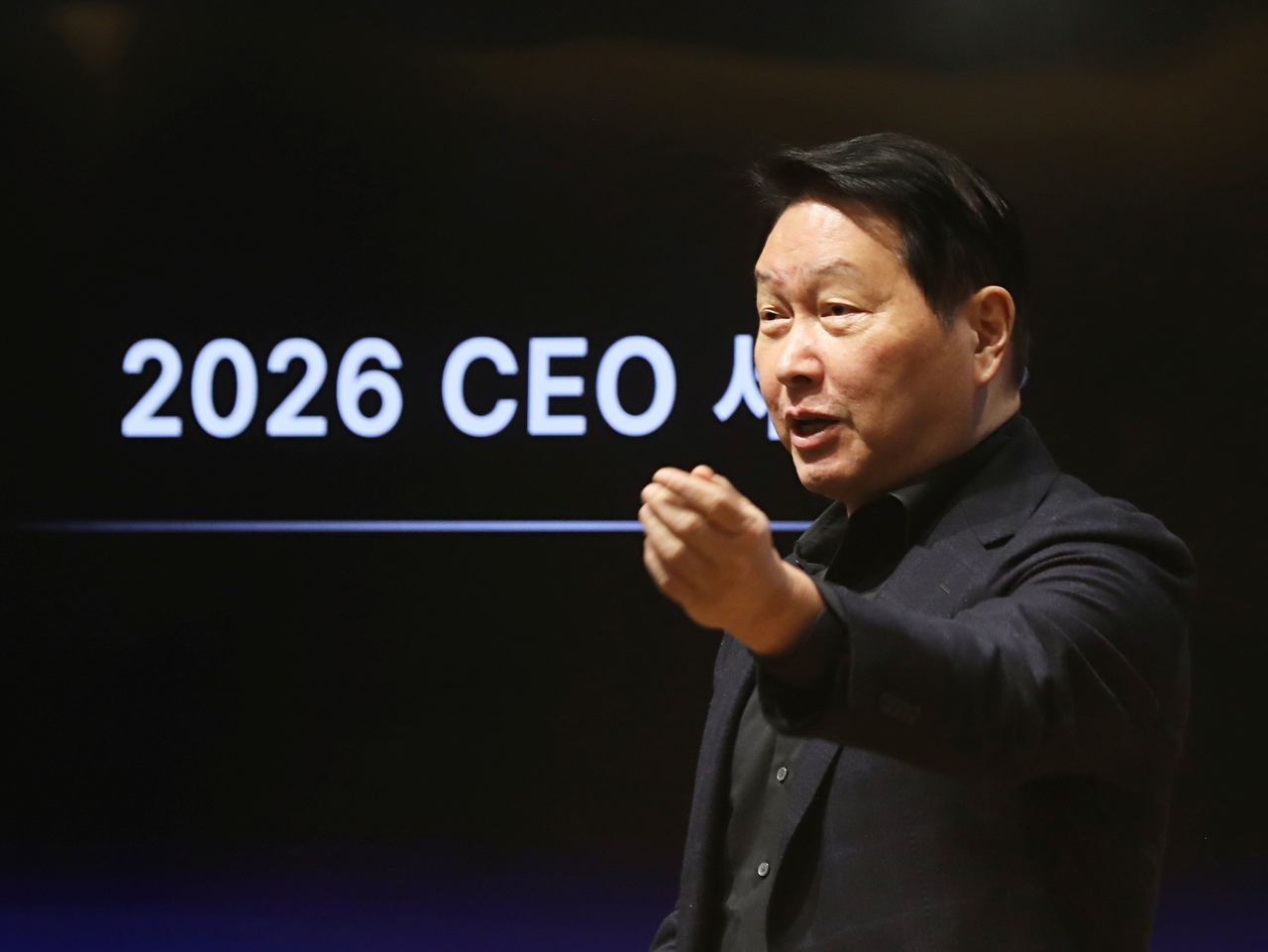
SK Group Chairman Chey Tae-won urged affiliates to pursue an “AI flywheel” strategy linking its semiconductor, infrastructure and energy businesses to new artificial intelligence services, the company said Sunday.
He presented the plan at SK’s 2026 CEO Seminar, held Thursday to Saturday at the SKMS Research Institute in Icheon, Gyeonggi Province. About 50 executives attended, including Executive Vice Chairman Chey Jae-won and SK Supex Council Chairman Chey Chang-won.
“We must break away from existing business frameworks and redefine ourselves as an AI company,” Chey Tae-won said, urging affiliates to identify opportunities beyond their traditional operations.
“No one can do everything alone in the AI era,” he added. “Open collaboration with global partners is essential to strengthening our capabilities and accelerating progress.”
The strategy envisions SK’s AI chips supporting the expansion of AI factories, increasing demand for electricity, energy infrastructure and services. Growth in those sectors would then drive further semiconductor investment and innovation.
SK also aims to expand into AI models and applications and participate in what it calls a “token economy,” where AI computing resources and services are traded.
During the seminar, executives reviewed emerging opportunities and potential risks while agreeing to continue its Portfolio Rebalancing 2.0 initiative to streamline inefficient operations and strengthen core businesses.
The group also plans to expand practical AI transformation across its operations to improve productivity and profitability.
SK hynix is upgrading its smart fabs using AI and digital twin technology to improve manufacturing efficiency. SK Innovation has introduced an ontology-based process map connecting equipment and operational data to improve production yields at its Ulsan CLX complex.
SK Telecom is automating network and service operations to boost productivity and customer experience, while SK Gas uses AI to analyze market conditions and organize operational knowledge for faster decision-making.
By Lim Ye-jin (yejinlim@heraldcorp.com)

