




Morgan Stanley warns of weaker profits from 2028, while Nomura sees memory shortages persisting
Global investment banks Morgan Stanley and Nomura are sharply divided over how long South Korea's AI-driven memory chip boom can last, with their price targets for SK hynix nearly threefold apart over conflicting expectations for the industry's profitability beyond 2027.
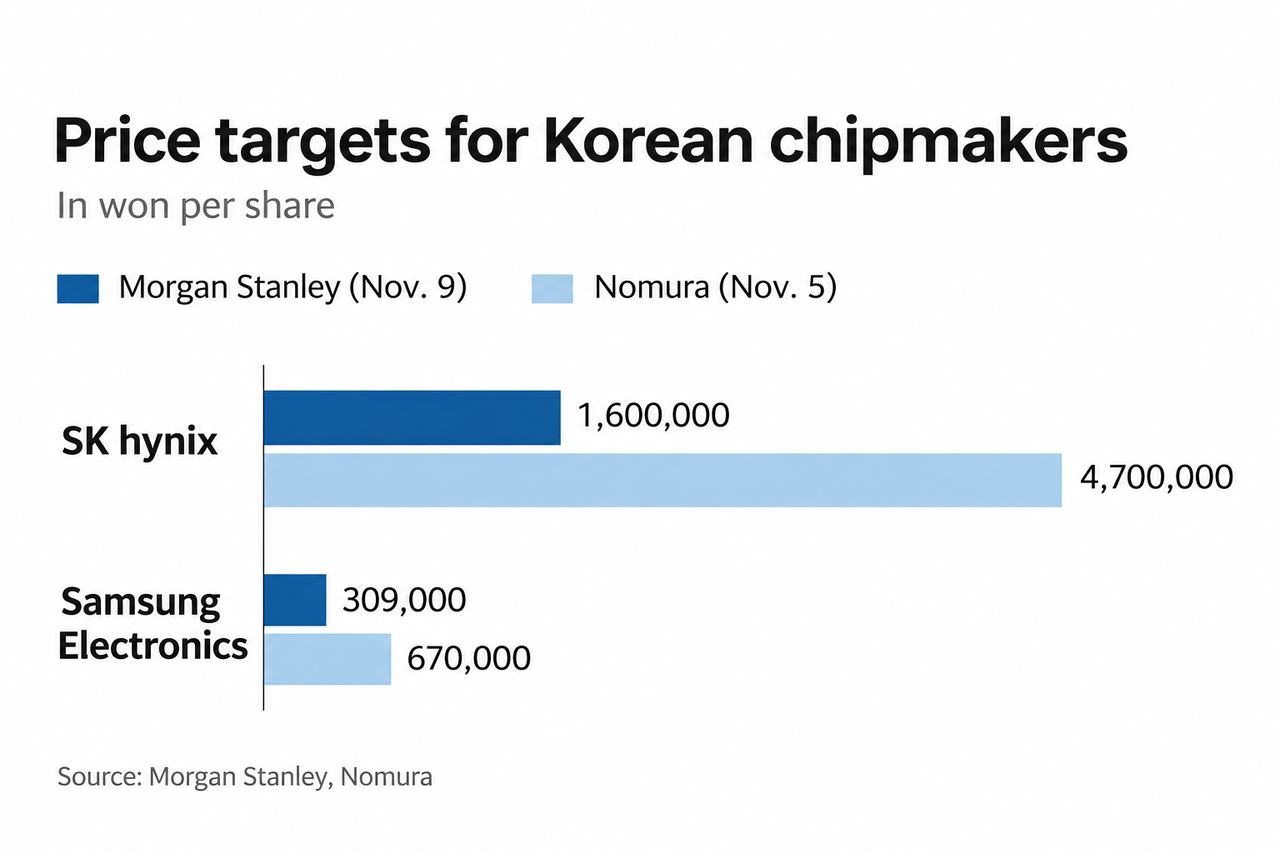
Morgan Stanley on Monday cut its target share price for SK hynix by 38 percent to 1.6 million won ($1,198) and lowered Samsung Electronics' by 19 percent to 309,000 won, citing risks from growing chip supply and delayed data center construction in 2028.
Nomura maintained targets of 4.7 million won for SK hynix and 670,000 won for Samsung in a report released last Thursday, respectively 2.9 and 2.2 times Morgan Stanley's revised estimates.
Both banks expect strong earnings next year. Morgan Stanley raised its 2027 operating profit forecasts for Samsung and SK hynix by 9 percent and 13 percent, respectively, but sharply reduced its longer-term margin assumptions.
"The most important debate in the memory market right now is whether we can avoid a 'cliff in earnings' in 2028," Morgan Stanley analyst Shawn Kim said in his Monday report.
For SK hynix, Kim cut the projected average operating margin for 2029 through 2035 from 53 percent to 28 percent, anticipating a return toward historically more typical profitability.
A central concern is AI data centers. Morgan Stanley's revised model pushes approximately 4.9 gigawatts of capacity previously expected in 2028 into 2029, lowering its forecast for growth in annual global data center capacity additions that year from 21 percent to 9 percent.
Annual additions would still rise to 43.3 gigawatts in 2028, but new memory production entering the market from late 2027 could begin catching up with demand. Increased output from Chinese manufacturers and narrowing premiums for high-bandwidth memory used in AI accelerators could further pressure prices.
Nomura reached a different conclusion in its Oct. 19 global memory report.
Combining data center construction forecasts with estimates of memory installed per system, the Japanese bank projected that memory demand growth would exceed supply growth "at least through 2028," supporting continued shortages and favorable pricing.
Nomura expects annual additions to global data center capacity to rise from 22.3 gigawatts in 2026 to 31.5 gigawatts in 2027. It maintained on Thursday that stricter US permitting requirements were more likely to delay or relocate projects than cancel them outright.
Kim Dong-won, head of research at KB Securities, also questioned whether US regulatory changes would substantially curb AI investment. "Given the AI data center projects already underway, we believe it is unlikely that Democratic-led regulations will lead to a reduction in AI infrastructure investment through 2028," Kim said.
SK hynix has secured longer-term customer commitments that could offer some protection against weaker demand. At its Oct. 28 earnings announcement, the company disclosed agreements with 14 major customers covering volumes equivalent to more than half its projected production capacity for 2027 and 2028.
The contracts include pricing arrangements that "reflect market conditions within a price range agreed upon with customers," leaving some exposure to future price declines.
Morgan Stanley's broader semiconductor market analysis found that forward earnings estimates for the Philadelphia Semiconductor Index had risen 24 percent during the latest downturn, even as its forward price-to-earnings multiple contracted 51 percent.
Despite its caution, Morgan Stanley retained overweight ratings on both Korean chipmakers and named Samsung its preferred semiconductor stock, citing its improving HBM position and earnings from businesses outside memory chips.
By Moon Joon-hyun (mjh@heraldcorp.com)

