




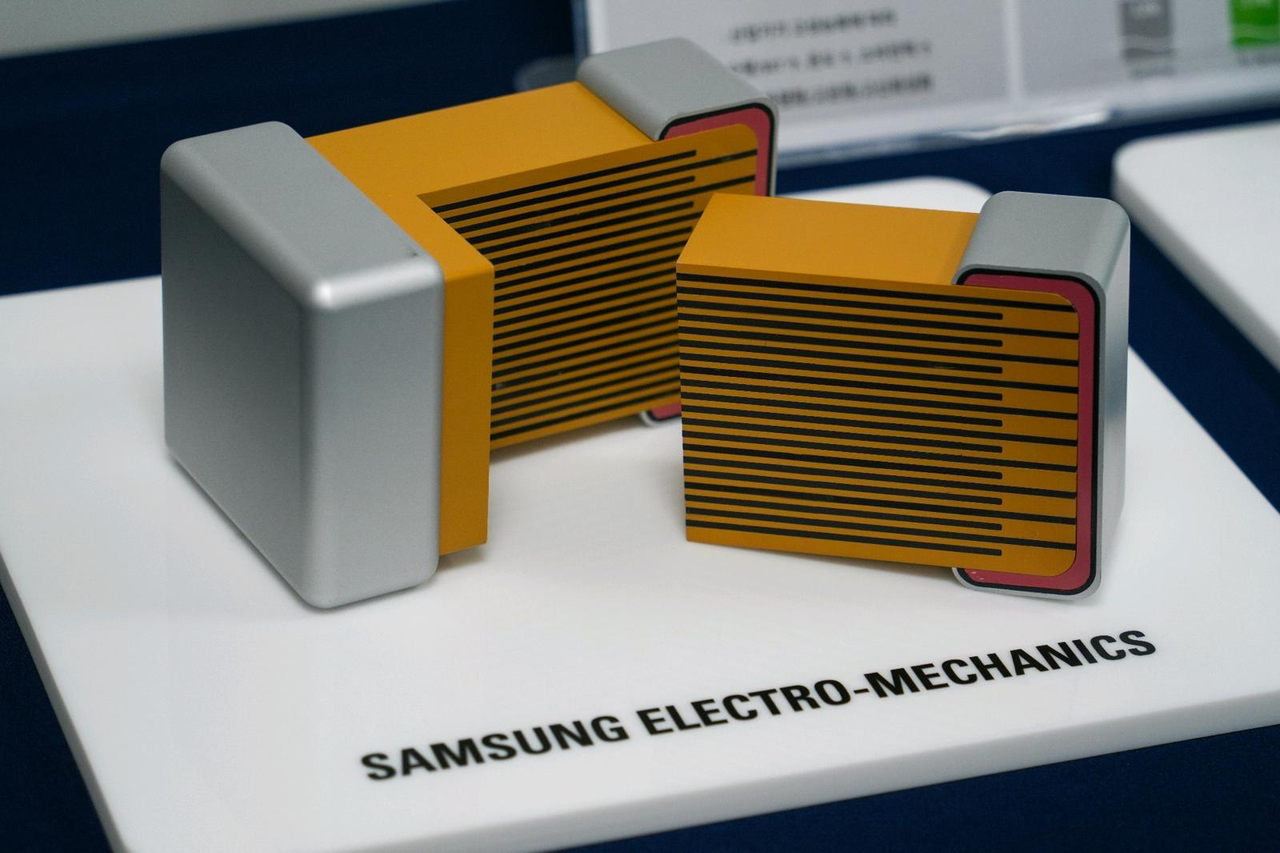
A widening shortage of high-performance capacitors used in AI servers is expected to intensify in early 2027, as surging demand for processors and memory drives new supply contracts at Samsung Electro-Mechanics and a major capacity expansion by Japanese rival Murata Manufacturing.
Market researcher TrendForce said Thursday that shortages of high-end multilayer ceramic capacitors, or MLCCs, would likely be most severe in the first two quarters of 2027, as AI infrastructure demand spreads beyond graphics processors to server CPUs, DDR5 memory and networking equipment.
MLCCs are tiny components that stabilize power supplied to processors and other electronic circuits. Advanced AI servers require high-capacitance, high-reliability versions to handle increasingly demanding power requirements.
The shift toward AI inference and autonomous AI agents is accelerating demand for server CPUs and accompanying memory. TrendForce expects global server CPU shipments to grow more than 40 percent next year.
Demand is also rising from AI accelerators. Nvidia's Vera Rubin platform is expected to ramp up shipments from the fourth quarter, while AMD has begun procuring specialized high-capacitance MLCCs for its MI450 platform, according to TrendForce.
Samsung Electro-Mechanics, a Samsung Electronics affiliate, is securing major orders amid the supply squeeze.
The company disclosed Friday an 879.3 billion won ($656 million) contract to supply AI server MLCCs to an unidentified global customer for one year starting Dec. 21.
The agreement brought its eight disclosed long-term supply contracts this year to approximately 5.18 trillion won, including other electronic components.
Samsung Electro-Mechanics reported record third-quarter revenue of 3.76 trillion won and operating profit of 691 billion won on Oct. 28, up 30 percent and 165 percent, respectively, from a year earlier.
Its component solutions division, which produces MLCCs, posted revenue of 1.88 trillion won, up 36 percent.
According to projections by Meritz Securities Research Center, Samsung Electro-Mechanics' AI-related MLCC revenue could rise from 374.9 billion won in 2025 to 2.98 trillion won in 2027 and 5.61 trillion won in 2028.
Meanwhile, Murata announced Friday plans to invest approximately 1 trillion yen ($6.3 billion) in MLCC production capacity from fiscal 2026 through 2030, targeting at least a doubling of sales by the end of that period.
Despite expansion plans, TrendForce expects high-end MLCC supply to remain tight through the first half of 2027, with pricing negotiations for the first quarter beginning this month.
By Moon Joon-hyun (mjh@heraldcorp.com)

