




Industry leaders call for open trade, diversified supply chains and faster adoption of manufacturing AI amid geopolitical uncertainty
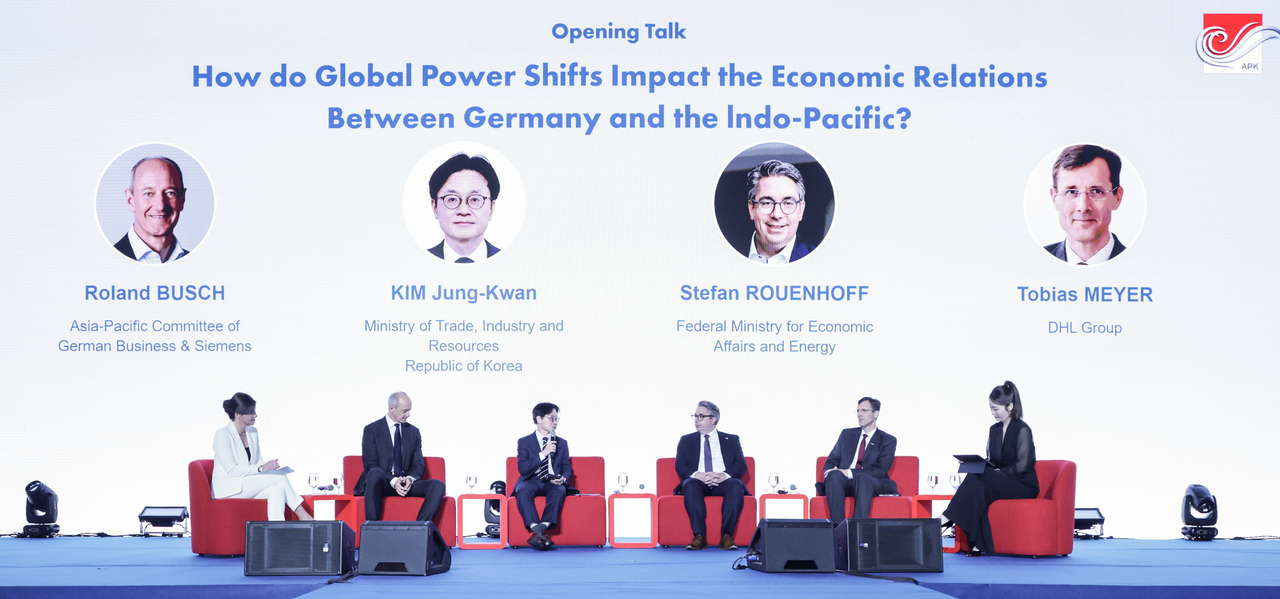
South Korea and Germany must strengthen economic security without retreating into protectionism, government and business leaders said Friday, calling for closer cooperation in industrial AI and supply chains as geopolitical tensions reshape global trade.
Speaking at the 19th Asia-Pacific Conference of German Business in Seoul, Industry Minister Kim Jung-kwan warned that efforts to reduce economic vulnerabilities should not come at the expense of open markets.
“Economic security should not become an excuse for economic isolation,” Kim said.
He cautioned against governments adopting the same restrictive practices they criticize in other countries, arguing that manufacturing and export-driven economies such as Korea and Germany must balance openness with resilience.
The panel brought together Kim, Stefan Rouenhoff, parliamentary state secretary at Germany's Federal Ministry for Economic Affairs and Energy, Siemens CEO Roland Busch and DHL Group CEO Tobias Meyer.
Meyer said global trade had remained resilient despite wars and US tariffs, supported by growing demand for new technologies.
“Tech beats tariffs,” he said.
But he warned that widening trade imbalances posed challenges: China had become increasingly innovative and cost-competitive, while Europe had lost ground partly because its industrial policies had failed to adequately support businesses.
Meyer cautioned that tariffs could backfire by raising costs for European manufacturers and undermining their export competitiveness. He called for continued dialogue with China rather than unilateral protectionist measures.
Globalization, he argued, was evolving rather than reversing, with companies diversifying production and sourcing to navigate uncertainty.
Turning to critical minerals, Kim called for closer Korean-German cooperation in securing alternative supplies and developing processing and recycling technologies.
He said Korea was expanding partnerships with resource-rich countries, while Germany's engineering expertise could complement Korea's strengths in batteries, semiconductors and materials processing.
“I believe the future of supply chain security lies not in self-sufficiency but in trusted interdependence,” Kim said.
Busch echoed the need for cooperation, warning that individual countries could not easily replicate supply chains built and optimized over decades. Diversification, he said, would require partnerships large enough to make alternative sources commercially viable.
Industrial AI emerged as another major opportunity for the two manufacturing powerhouses.
Busch said existing AI models were already capable of supporting industrial applications, but access to specialized manufacturing data, industry expertise and rapid deployment would determine which companies gained a competitive edge.
Rouenhoff described industrial AI as a key opportunity to restore Germany's industrial competitiveness, calling for targeted government support and deeper cooperation with Korea under their new bilateral high-tech framework.
Kim stressed that the AI race was moving beyond developing powerful models, advanced chips and data centers toward applying the technology in factories and production systems.
He said Korea's manufacturing AI initiative aims to accelerate that transition through collaboration among businesses, researchers and the government.
“The next stage of AI competition will not be decided by technology alone,” Kim said. “It will be decided by how quickly we transform technology into productivity.”
By Jo He-rim (herim@heraldcorp.com)

