




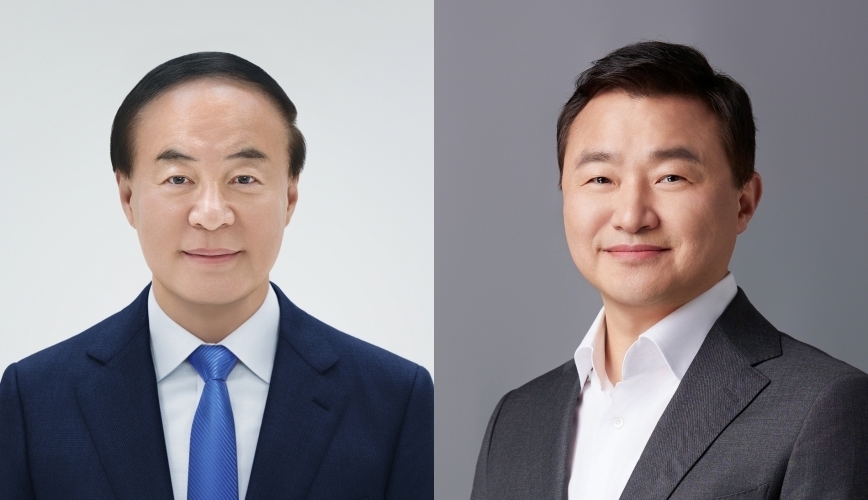
Samsung Electronics' co-CEOs struck a cautious tone Friday ahead of the tech giant's 57th anniversary.
Jun Young-hyun, head of the device solutions division, warned that record profits do not mean a full recovery in technological competitiveness, while Roh Tae-moon, who leads the device eXperience division, called for tighter cost controls.
The two delivered separate anniversary messages to employees as the company prepares to mark the occasion Sunday without a formal ceremony.
Their remarks came a day after Samsung reported a record 107.44 trillion won ($80.5 billion) in third-quarter operating profit, driven overwhelmingly by its semiconductor business. The DS division accounted for 106.5 trillion won of that profit. The DX division, which oversees smartphones, TVs and home appliances, posted an operating loss of 800 billion won for the second consecutive quarter.
Despite the record earnings, Jun cautioned against taking the current AI-driven chip boom for granted.
"No one knows how long the market boom will last, while external challenges are intensifying," he said.
Jun thanked employees for their efforts but stressed that the semiconductor business needs to become less vulnerable to swings in market conditions, particularly as global economic and industry uncertainties persist.
He also acknowledged that the division's recent earnings recovery had yet to be matched by a full restoration of its technological edge.
"Although our earnings have improved recently, it is difficult to say that our technological competitiveness has fully recovered," Jun said, urging employees to refocus on the fundamentals of technology and quality.
The warning reflects a broader concern that strong demand for AI chips and favorable market conditions alone will not guarantee Samsung's long-term competitiveness.
Jun also addressed the importance of workplace culture following tensions between management and labor over semiconductor performance bonuses earlier this year.
He said technological strength ultimately rests on people and organizations, identifying customers, technology, collaboration, execution and ethics as five values the division should uphold.
For Roh, the immediate challenge lies in restoring profitability at Samsung's consumer electronics business, where rising component prices and sluggish demand have put pressure on margins.
Roh said Samsung must strengthen the fundamentals of its device business, including product quality, overall execution and operational efficiency, to defend its market leadership.
With devices serving as the main gateway through which consumers experience AI services, he stressed that the quality of Samsung's hardware remains critical to its competitiveness.
He also called for closer monitoring of supply chain risks and more proactive management of component costs, saying the division needs to secure a stronger cost advantage in an increasingly uncertain business environment.
Beyond its existing product lines, Roh pledged to accelerate efforts to develop new growth engines in robotics, heating, ventilation and air conditioning (HVAC), medical technology and automotive electronics.
He said the company would continue investing in core technologies, development and manufacturing infrastructure, and innovation to lay the groundwork for sustainable growth.
Roh also placed emphasis on AI transformation, calling for a fundamental change in the way Samsung operates.
He urged employees to accelerate the overhaul of internal work processes and help turn Samsung into a leading AI-native company.
"Samsung Electronics' 57-year history has been one of overcoming crises and making new leaps forward," Roh said.
Samsung Electronics was established on Jan. 13, 1969, as Samsung Electronics Industry but adopted Nov. 1 as its official founding anniversary following its merger with Samsung Semiconductor & Telecommunications in 1988.
By Jie Ye-eun (yeeun@heraldcorp.com)

