




Chung Euisun meets Modi as Korean auto giant plans to expand manufacturing, R&D and local partnerships through 2032
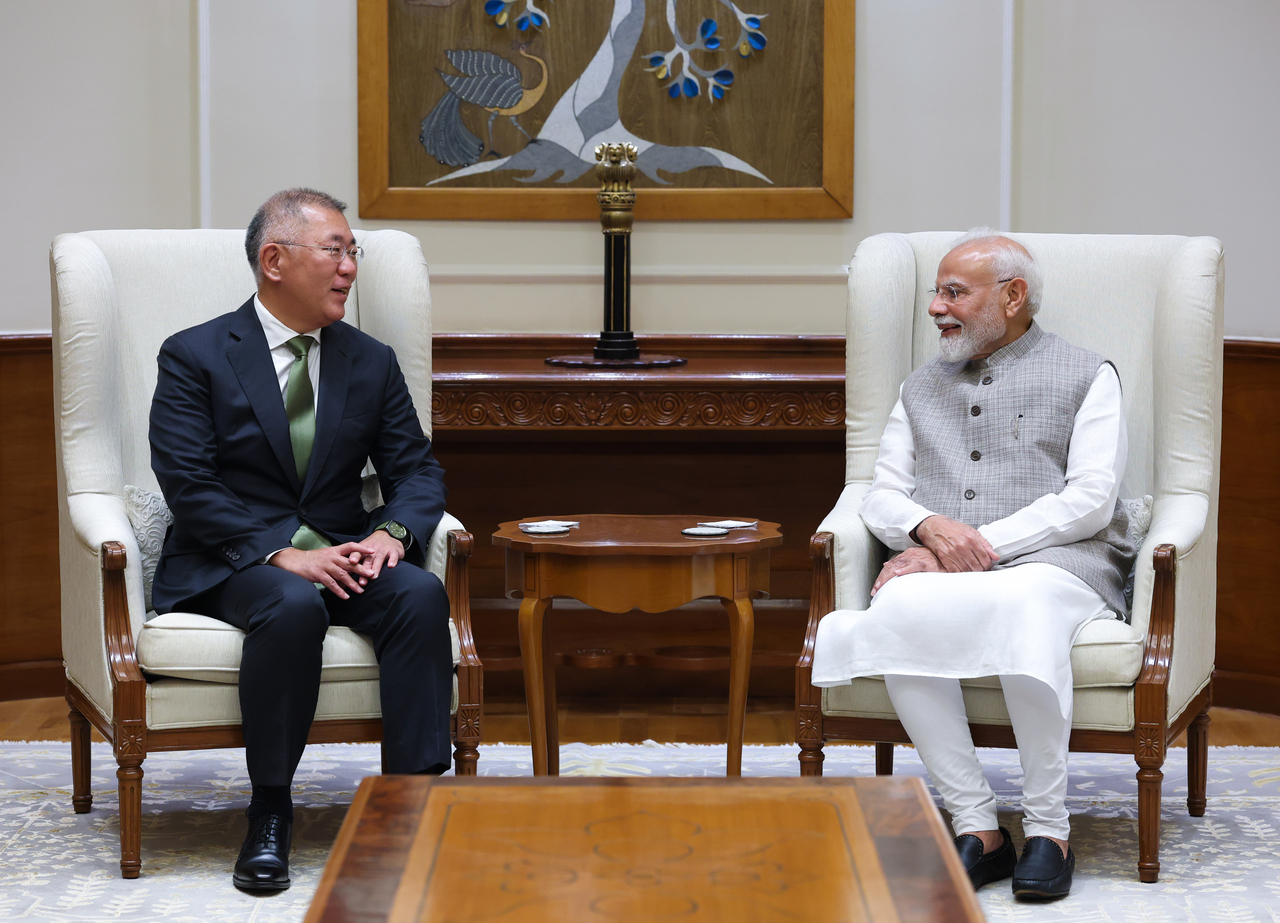
NEW DELHI — Hyundai Motor Group is investing $15.5 billion in India over the next seven years, as the Korean auto giant moves to create a major production and export hub in the world's third-largest auto market.
Executive Chair Chung Euisun outlined the commitment during talks with Indian Prime Minister Narendra Modi in New Delhi on Tuesday, unveiling plans to expand vehicle production, strengthen research and development and broaden supply chains through 2032.
The meeting, their eighth, underscored the group's growing ambitions in India, where the Hyundai brand is approaching 10 million cumulative vehicle sales and the group's combined market share already ranks second, behind Maruti Suzuki, at 19 percent.
The investment will also support future mobility technologies and closer partnerships with Indian companies, aligning with Modi's push to strengthen domestic manufacturing under his "Make in India" initiative.
Under the plan, Hyundai will expand production facilities and establish additional R&D infrastructure, while recruiting local engineering talent to develop vehicles and technologies tailored to Indian consumers.
The group will also establish a dedicated investment entity to coordinate funding for research facilities and emerging technologies, identify promising local suppliers and facilitate partnerships across the automotive industry.
Hyundai said the investment would create jobs across manufacturing, engineering, research and supply-chain operations. The group currently employs more than 24,000 people in India.
The commitment builds on Hyundai's expanding manufacturing presence, including its recently opened Pune plant in Maharashtra. Hyundai also operates two plants in Chennai, while affiliate Kia runs a manufacturing facility in Anantapur.
Chung told Modi that Hyundai has grown alongside India since entering the market in 1996 and is preparing for its next phase of expansion.
India has become a pillar of Hyundai's global operations, serving both as a major domestic market and a potential export hub for emerging economies.
Hyundai began selling locally manufactured vehicles in 1998 with the Santro compact car produced at its Chennai plant. By the end of the third quarter this year, cumulative sales in India had reached 9,884,960 vehicles, putting the company on track to surpass 10 million before year-end.
India's passenger vehicle market is projected to grow from 4.57 million units in 2025 to 5.25 million this year.
The group's growing local production capacity allows it to respond more quickly to domestic demand, and gives it a price advantage, as India's vehicle import tariffs can reach 110 percent.
Beyond conventional vehicle manufacturing, Hyundai is seeking opportunities in emerging mobility businesses.
In partnership with Indian two-wheeler manufacturer TVS Motor Company, Hyundai has developed an electric three-wheeler prototype, targeting commercial launch by late 2027.
The group is also exploring mobility services, vehicle financing, EV charging infrastructure and end-of-life vehicle recycling.
Chung highlighted India's potential as a strategic export base for the Global South, particularly the Middle East and Africa, citing competitive production costs and geographical advantages.
Hyundai also emphasized its commitment to local communities, saying Hyundai, Kia and Hyundai Mobis contributed approximately $110 million to social initiatives in India between 2016 and 2025.
By Byun Hye-jin (hyejin2@heraldcorp.com)

