




Hana, Shinhan pursue consolidation; KB deepens Yeouido base; Woori seeks cash
South Korea’s major financial groups are reworking their headquarters strategies, either consolidating affiliates to boost operational efficiency or monetizing real estate assets to shore up capital and support expansion.
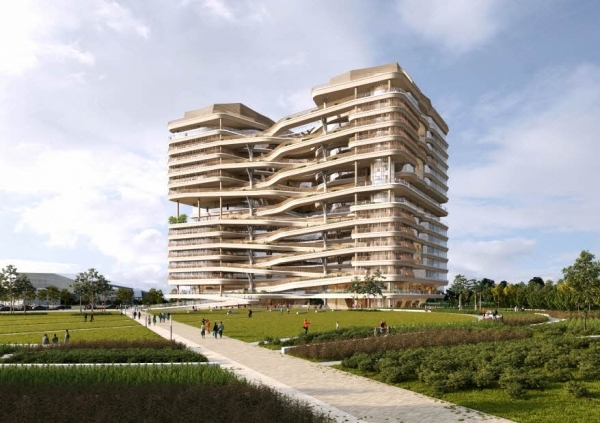
Hana Financial Group is set to relocate its headquarters to Cheongna, Incheon, later this year, in a move aimed at bringing together affiliates currently scattered across Seoul — from the central business district to Yeouido — into a single integrated complex.
Key subsidiaries — including Hana Bank, Hana Life Insurance and Hana Card — with around 2,800 employees are expected to relocate to the new site.
“The relocation to the new Cheongna headquarters will go beyond a simple change of space and serve as a turning point to realign the group’s capabilities and break from outdated practices,” Chairman Ham Young-joo said in a management report released earlier this year.
“Hana Financial aims to take growth to the next level from the new base, combining a state-of-the-art working environment with an innovative corporate culture,” he added.
Shinhan Financial Group is pursuing a similar consolidation strategy, but within central Seoul. The group plans to bring together affiliates currently dispersed across the city into the Shinhan Financial Tower in Gwanggyo-dong, near Cheonggyecheon.
Although the redevelopment project faced repeated delays, it secured approval in 2024 and is now under construction, with completion slated for 2031.
KB Financial Group, meanwhile, is reinforcing its base in Yeouido. After declaring the “Yeouido era” in 2020 with the relocation of its headquarters to a newly built office tower, the group is expected to deepen cooperation in the area as its key affiliate, KB Kookmin Bank, moves forward with plans to redevelop its own headquarters nearby.
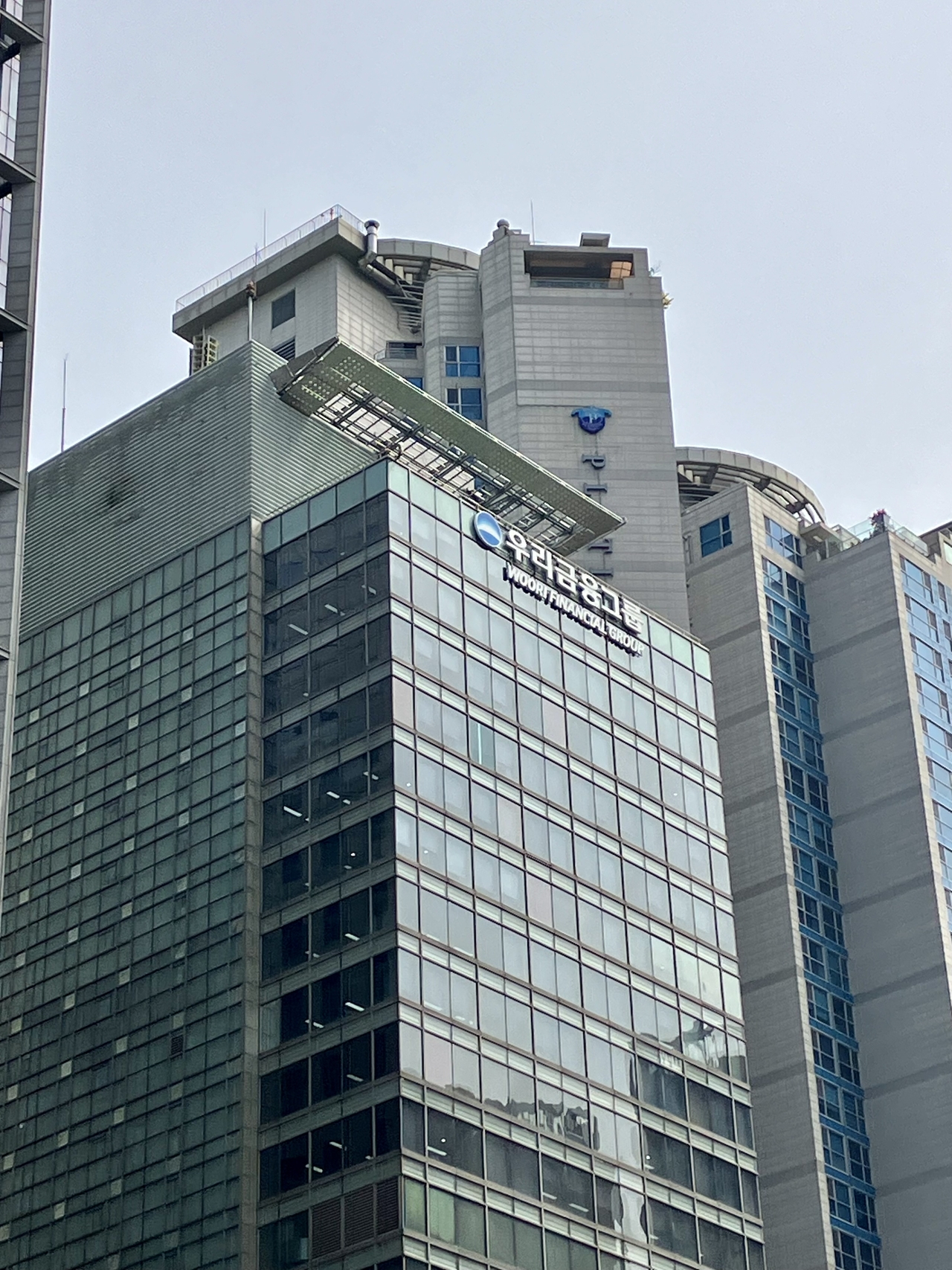
In contrast, Woori Financial Group is focusing on liquidity rather than consolidation. The group is seeking to sell its Woori Financial Digital Tower — one of its prime real estate assets — to secure cash flow following a series of recent acquisitions.
Last year, Woori acquired Tongyang Life Insurance and ABL Life Insurance to strengthen its nonbanking portfolio. A year earlier, it bought Korea Foss Securities, later merging it with Woori Investment Bank to launch Woori Investment & Securities.
With rapid expansion expected to weigh on capital adequacy, the Financial Supervisory Service has required the group to submit a mid- to long-term capital management plan on a semiannual basis through 2027, effectively urging it to reinforce its capital base.
Against this backdrop, Woori plans to divest the Digital Tower property, which it acquired in 2019 for 209.2 billion won ($140 million). The sale is expected to generate a capital gain of around 200 billion to 300 billion won.
The divestment effort extends to smaller assets as well, including the sale of multiple branches and a training center.
The group’s IT divisions currently occupy the Digital Tower. If the deal proceeds under a sale-and-leaseback structure, day-to-day operations are unlikely to be disrupted, though it could signal a shift in Woori’s headquarters strategy, which has centered on expanding its footprint around Hoehyeon Station in central Seoul.
“Woori Financial’s Digital Tower sale is likely to provide a meaningful boost to its common equity tier 1 ratio, a key metric for financial holding companies,” an official at a local lender said.
By Im Eun-byel (silverstar@heraldcorp.com)

