




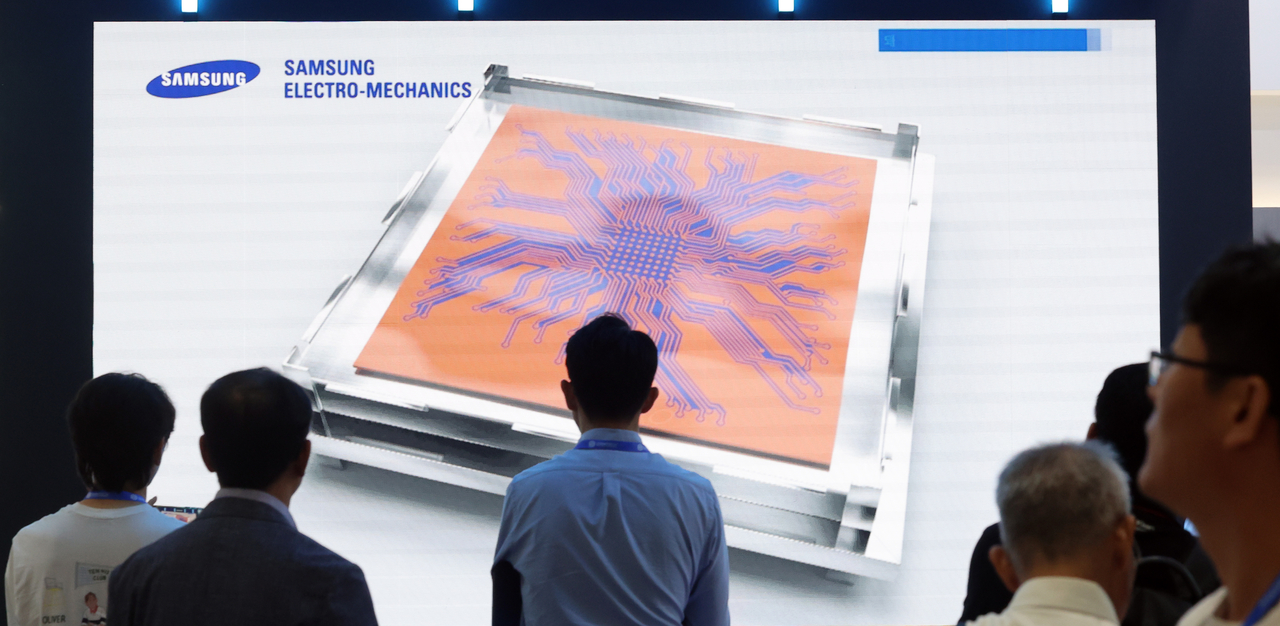
Samsung Electro-Mechanics is reportedly pouring over 1 trillion won ($662.3 million) into capital expenditure for a second consecutive year, concentrating its investment on FC-BGA substrates, a critical component in AI server chips, as demand far outstrips its production capacity.
The company's server and data center FC-BGA lines are running at full capacity, yet supply still falls short. CEO Chang Duck-hyun told shareholders at the annual general meeting last month that demand for the product exceeds production capacity by more than 50 percent. According to industry sources, Samsung Electro-Mechanics is expanding facilities at its Busan and Sejong plants to close the gap, while carrying out supplementary investments in existing lines.
FC-BGA, or flip-chip ball grid array, is a high-end substrate that connects advanced semiconductors to circuit boards, requiring precise high-speed signal routing and thermal management. AI server processors generate far more heat and consume more power than conventional chips, pushing up the layer count and precision required in substrates and creating a high barrier to entry.
The supply squeeze is feeding directly into pricing. The company has raised prices on select FC-BGA products, leveraging a seller's market created by raw material cost increases and persistent shortages. Mirae Asset Securities noted in a recent report that Samsung Electro-Mechanics' substrates are effectively sold out, and revised its FC-BGA price estimates upward by roughly 10 percent.
Multilayer ceramic capacitors, or MLCCs, are following a similar trajectory. High-capacity, high-reliability capacitors used in AI servers are seeing tightening supply, and Samsung Electro-Mechanics holds what Yujin Investment & Securities analyst Lee Joo-hyung described as an oligopolistic position alongside Japan's Murata Manufacturing in the AI server MLCC segment.
Lee noted that Murata has begun internal discussions on MLCC price hikes, giving Samsung Electro-Mechanics grounds to raise prices as well.
Yujin raised its target price on the stock by 64 percent, from 360,000 won to 590,000 won, projecting average annual operating profit growth of 50 percent through 2028 across all three of the company's business divisions. Kyobo Securities struck a similar tone last month, lifting its target to 600,000 won and forecasting that operating profit would double within two years as both MLCC and FC-BGA enter simultaneous upcycles.
For the package solutions unit specifically, Yujin expects ABF substrate line utilization to climb from the mid-70 percent range last year to above 80 percent in the first quarter and 90 percent in the second half, with output fully booked through next year. A decision on large-scale capacity expansion is anticipated in the first half of this year to address demand beyond 2028.
Beyond semiconductors, Samsung Electro-Mechanics is diversifying into automotive and aerospace applications, including expanding camera module production for autonomous vehicles and building out a factory in Mexico to serve North American clients.
By Moon Joon-hyun (mjh@heraldcorp.com)

