




Union backlash over Atlas robot highlights looming industry challenge — as Tesla pushes ahead
“Not a single robot will be allowed onto the factory floor without a labor-management agreement.”
That warning, issued Jan. 22 by Hyundai Motor Group’s labor union and reiterated a week later, has cast a shadow over the automaker’s much-hyped push into humanoid robotics — and may offer a preview of a broader labor challenge facing the global auto industry.
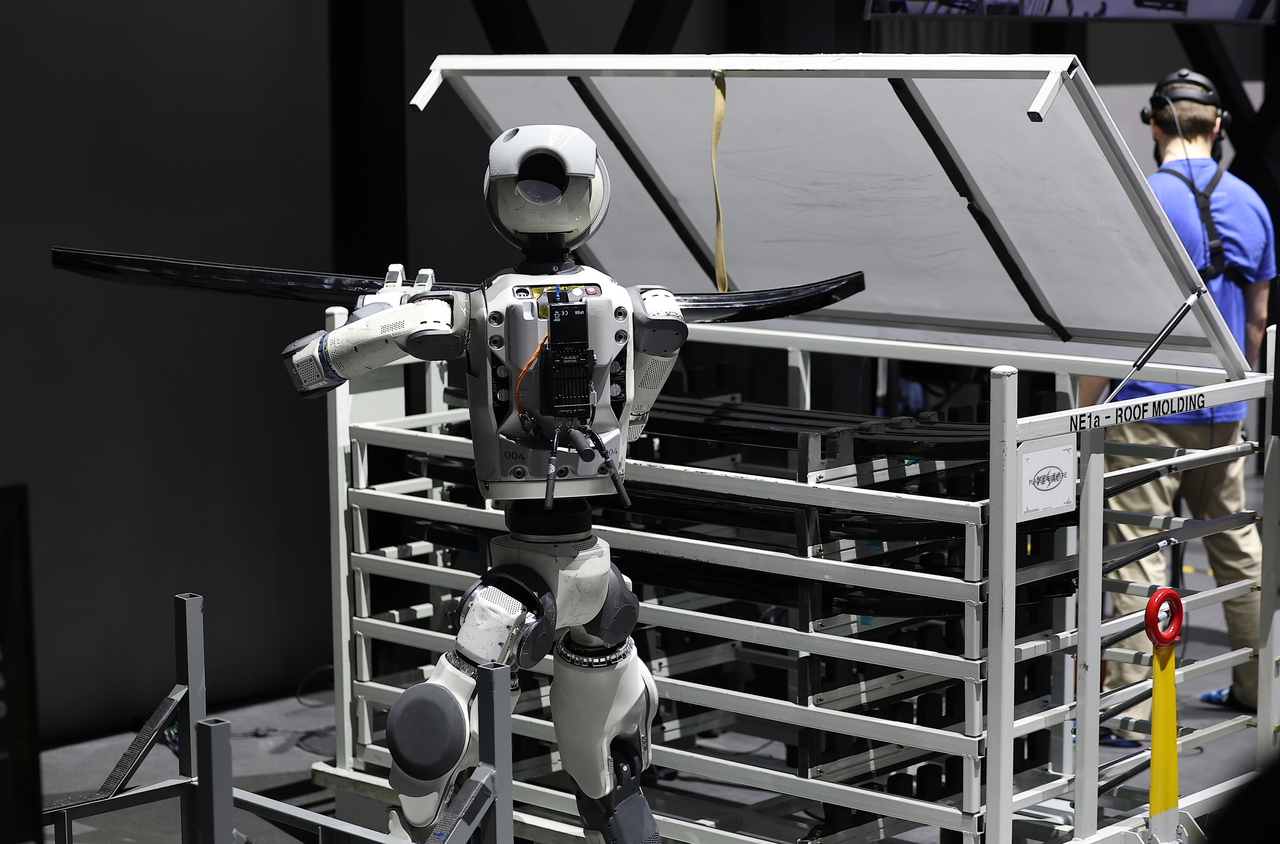
At issue is Atlas, the humanoid robot developed by Boston Dynamics, which Hyundai plans to begin deploying at its new Metaplant in Georgia from 2028. While humanoid robots remain years away from mass deployment, Hyundai’s concrete timeline has pushed a largely theoretical debate into the real world, making its labor union the first at a global automaker to openly oppose the technology on production lines.
The standoff underscores a question the industry can no longer ignore: not whether humanoid robots will enter factories, but how — and on whose terms.
Cost fears fuel early backlash
For Hyundai’s union, concern centers less on Atlas’ current capabilities than on its long-term economics.
The union estimates that operating a 24-hour production line requires three workers at an average annual cost of about 300 million won ($69,400 per worker). By contrast, a humanoid robot — once purchased — requires only maintenance and electricity.
Industry estimates put Atlas’ price at roughly 200 million won per unit, with annual maintenance costs of about 14 million won. With no need for breaks or shift changes, the union argues that robots could eventually outcompete human labor on both cost and productivity, creating strong incentives for workforce reduction.
“For capital seeking long-term profit maximization, robots offer a compelling rationale,” the union said.
Experts: disruption is real — but distant
Yet experts caution that the feared displacement remains far off.
“Atlas may master one or two specific tasks in the near term,” said Chang Tai-woo, an industrial engineering professor at Kyonggi University. “But replacing skilled workers at scale would require breakthroughs approaching artificial general intelligence — a process likely to take decades.”
A robotics researcher at a state-run institute echoed that assessment, estimating it would take at least four to five years before Atlas becomes meaningfully usable in factory settings. It would be far longer to deliver a viable return on investment.
For now, experts say, cheaper and more specialized industrial robots remain far more practical for repetitive tasks.
Why Hyundai is feeling it first
Still, the momentum behind humanoid robots appears difficult to reverse.
Hyundai’s labor friction is less about technological readiness than timing. Unlike rivals, Hyundai has already set a clear deployment roadmap that starts overseas, turning a future concern into an immediate bargaining issue.
The company plans to pilot Atlas at its Georgia plant, where union resistance is absent, and proximity to Boston Dynamics offers logistical advantages. Domestic rollout, experts say, would likely follow only after extended negotiations.
Chang noted a familiar pattern: Hyundai’s union fiercely opposed smart factory initiatives when they were first introduced under a government program in 2014. Today, those technologies are embedded across Hyundai’s operations, including at its largest plant in Ulsan.
“Overseas facilities often become testing grounds,” Chang said. “By the time technologies reach domestic plants, they’re already proven.”
Tesla moves faster — without unions
Hyundai’s cautious approach contrasts sharply with Tesla, which is pushing ahead with its Optimus humanoid robot.
Unburdened by union opposition, Tesla plans to begin training Optimus and collecting manufacturing data at its Austin Gigafactory as early as February, according to Business Insider. CEO Elon Musk has targeted commercial rollout by late 2026, with broader sales from 2027 — a timeline that, if realized, would outpace Hyundai’s Atlas roadmap.
Experts warn that prolonged labor standoffs could slow Hyundai’s adoption curve relative to global competitors, even if humanoids take years to mature.
“In the short term, resistance protects jobs,” Chang said. “But in the long term, it risks hollowing out manufacturing leadership if core technologies are validated elsewhere.”
A test case for auto industry
For now, the humanoid debate remains embryonic. No automaker is close to replacing large numbers of workers with human-like robots.
But Hyundai’s experience suggests the issue will not remain theoretical for long. As humanoid robotics moves from lab demonstrations to pilot deployments, labor relations — not just technology — may determine who leads the next phase of manufacturing.
In that sense, the standoff at Hyundai is less an anomaly than an early warning.
By Byun Hye-jin (hyejin2@heraldcorp.com)

