




Lee Jae-yong returns from Tesla, AMD talks for separate briefing
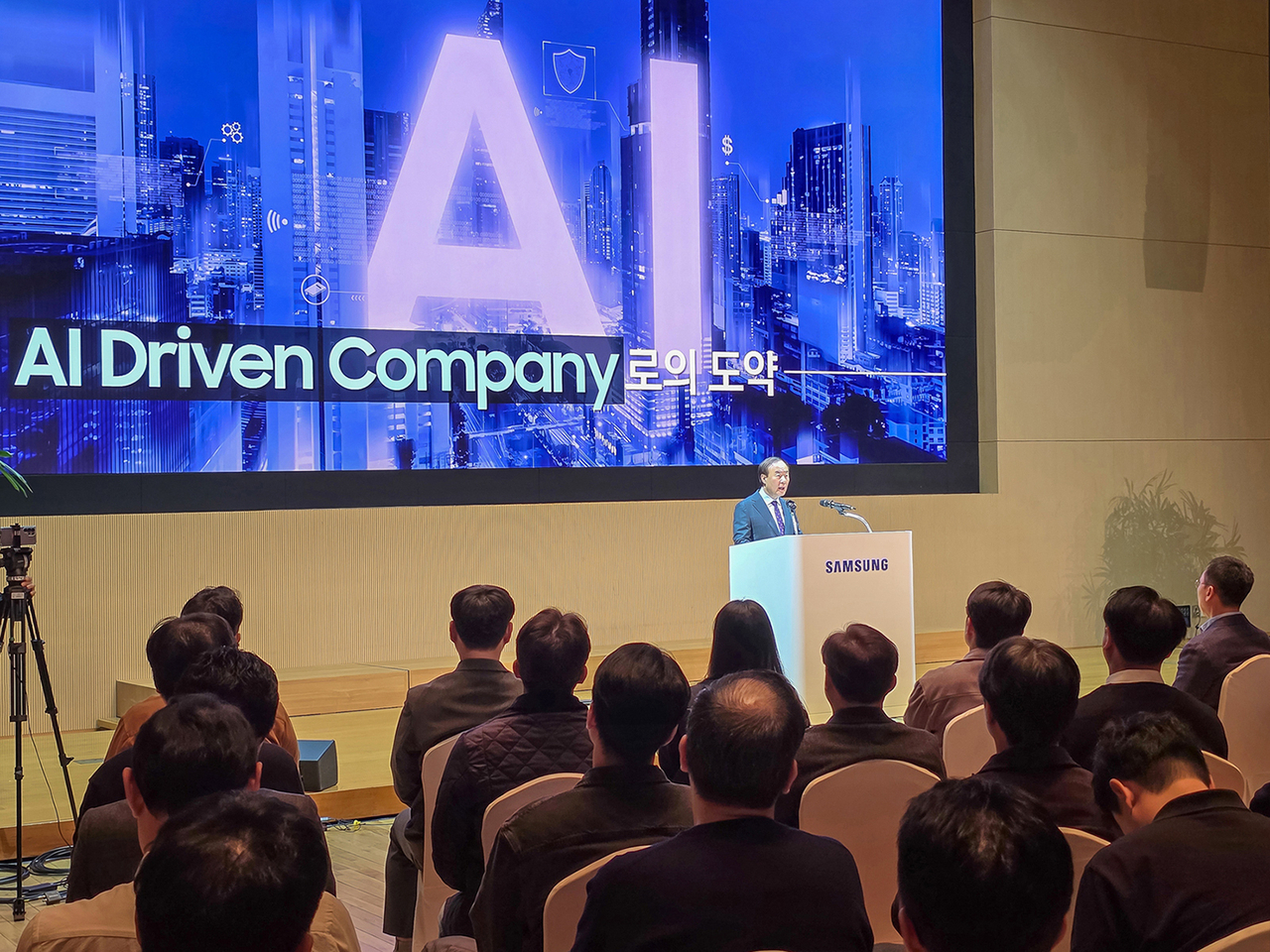
Samsung Electronics has kicked off its year-end global strategy meeting as it lays out a roadmap for 2026 amid mounting industry pressure.
The closed-door sessions, held from Tuesday to Thursday, follow the company’s major leadership reshuffle in November. Divisional leaders Roh Tae-moon and Jun Young-hyun, recently appointed as co-CEOs of the consumer devices and semiconductor businesses, respectively, are chairing the three-day strategy review.
Chair Lee Jae-yong returned from the United States the night before the meeting but will be briefed separately. He reportedly had meetings with Tesla CEO Elon Musk and AMD CEO Lisa Su, focusing on semiconductor cooperation and expanding Samsung’s role as a key chip supplier to American tech giants.
At the center of discussions are Samsung’s plans to expand its role in the AI supply chain. The company is pushing to position itself as a key provider of memory and foundry services for AI-centric computing, not just for general-purpose graphics processing units but increasingly for custom-built ASIC chips, used by firms like Amazon and Meta.
According to KB Securities, Samsung plans to allocate 60 percent of its high-bandwidth memory output in 2026 to ASIC clients. However, Samsung is still undergoing quality certification from Nvidia for its latest HBM4 chips, while rival SK hynix recently began supplying HBM4 to the US chip giant. The chips are critical to next-generation AI accelerators such as Nvidia’s Rubin platform, and are expected to power the next wave of large-scale AI systems.
Samsung’s other strategic focus is its US-based foundry operations. The company is preparing to start production at its $37 billion Taylor, Texas, facility in 2026, using its advanced 2-nanometer process. That factory has become central to Samsung’s foundry ambitions, especially following a $16.5 billion contract signed in July to manufacture Tesla’s upcoming AI6 chip. Tesla CEO Elon Musk has also confirmed that Samsung will produce part of the AI5 chip series, initially planned for Taiwan’s TSMC.
The foundry unit’s progress with 2-nanometer manufacturing will be closely watched, as it directly affects Samsung’s ability to close the technological gap with TSMC, which holds over 70 percent of the global foundry market. Samsung’s share stands at 8 percent, according to TrendForce.
In mobile, Samsung is finalizing launch plans for its Galaxy S26 series, expected in February. One major focus is the company’s new Exynos 2600 processor, built on Samsung’s in-house 2-nanometer technology. However, production yields remain a bottleneck. Analysts project that the Exynos 2600 may only appear in limited markets, with Qualcomm’s Snapdragon 8 Gen 4 expected to supply the majority of S26 units globally.
Meanwhile, Samsung’s consumer electronics divisions are doubling down on AI-driven features to stay competitive in a slowing market. With new robot vacuum models and AI TVs set to debut in January at CES 2026 in Las Vegas, the company aims to distinguish its products amid rising pressure from Chinese brands.
Vice Chair Jun, who now leads the semiconductor business, emphasized in a recent internal address that Samsung must merge its proprietary technologies with AI capabilities to become a "truly AI-driven company."
By Moon Joon-hyun (mjh@heraldcorp.com)

